

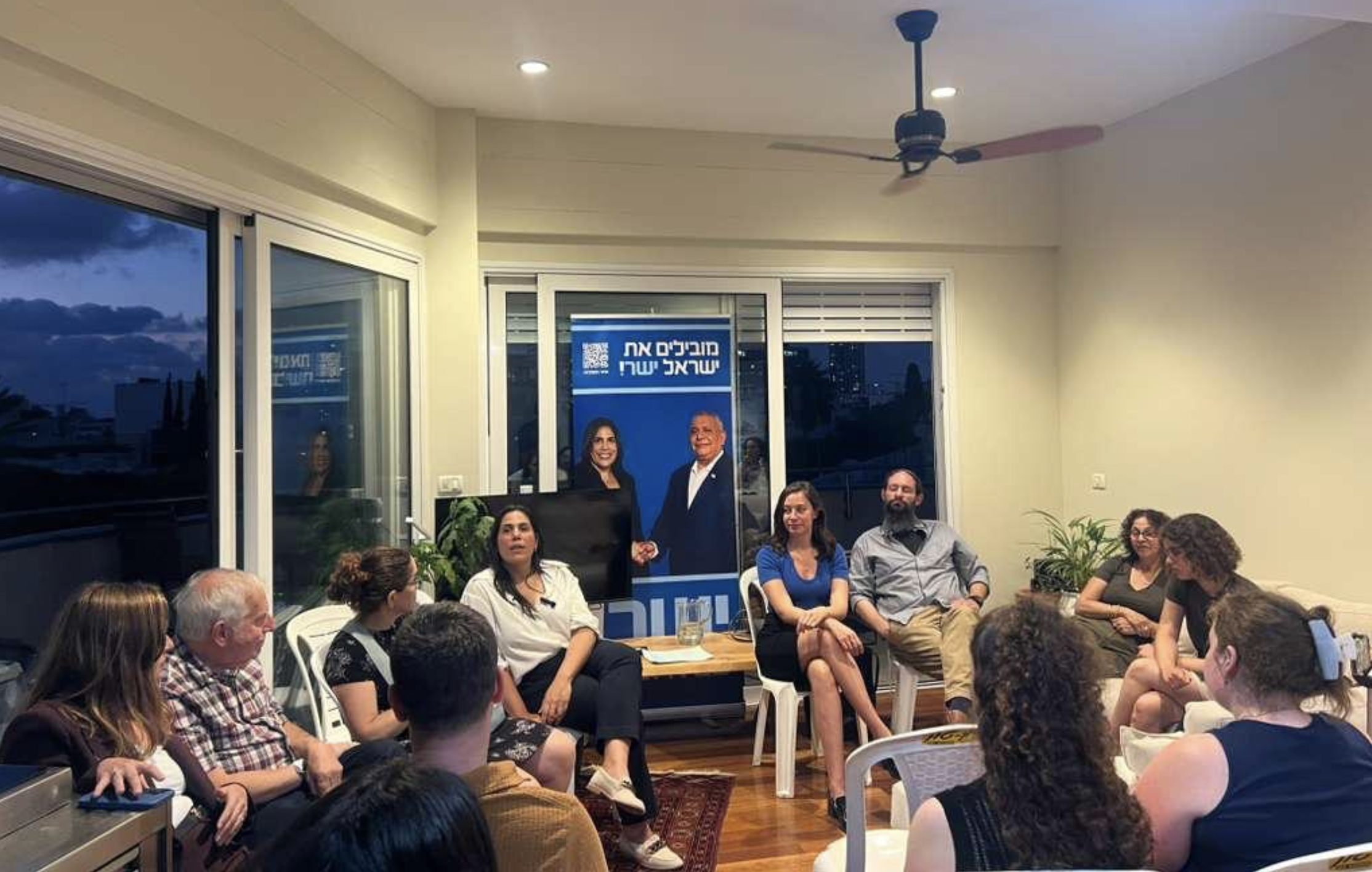
On the very same night in which Gadi Eisenkot formally launched his Yashar election campaign under the slogan “Israel Must Win,” one of the party’s key architects came to speak to a room full of internationals in English. Inbar Harush Gity, a co-founder of Yashar and former senior leader in the Israeli Ministry of Defense, spent the better part of an evening walking through two of the most contested questions in Israeli domestic politics: who owes a debt to the state, and what kind of country does Israel want to be moving forward?
The event, taking place in a supporter’s home, allowed for the international community to learn about the party and ask questions in English. This is all part of Tribe Tel Aviv’s Election Series, which is highlighting all the political parties ahead of the October 27th, 2026 election.
Yashar, the Hebrew word for “straight” or “upright,” was founded by former IDF Chief of Staff Gadi Eisenkot in September 2025 after he resigned from Benny Gantz’s National Unity party. He formally launched his campaign on June 30, vowing to replace what he called a government defined by “chaos” and division. The timing also couldn’t be more relevant, as the latest polls show Yashar running neck and neck with Netanyahu’s Likud at roughly 21 to 23 seats each, making Eisenkot the prime minister’s most serious challenger heading into the October elections.
Harush Gity’s role within the movement is distinct. Having been born to a family of Moroccan Jewish descent, she came up through nonprofit and civic leadership before transitioning into government and defense ministry work. This background shapes how she approaches the movement’s core project: identifying a shared Israeli identity that cuts across religious, ethnic, and political lines.
“It’s the first serious way to figure out talking about central politics to the Israeli public,” she said at the event. “Not the right, not the left – but a new way of thinking that isn’t lacking in ideas.”
She repeatedly returned to the country’s first Prime Minister, David Ben Gurion. The founding generation built a state under tremendous pressure – absorbing refugees, constructing institutions, and forging a national identity from practically nothing. However, the pluralism that emerged from that era transformed, over time, into tribalism. There is “only five percent commonality between people,” she said in her comments describing this fragmentation. Yashar’s central project, as she framed it, is to find and build upon what remains shared – a mutual core beneath the sectarian divisions. That ambition partially extends to immigration: Eisenkot has unveiled a plan to bring two million Olim (new immigrants) to Israel by 2048, the country’s centennial, by cutting bureaucracy and expanding incentives for new immigrants and returning residents. Based on some comments from Olim at the event in regards to their frustration of their lack of representation in government currently, this particular initiative certainly has a decent way to go.
The most direct domestic application of that framework is the Haredi (Ultra Orthodox) militar draft, perhaps the single most combustible issue in Israeli politics right now. Under the current arrangement, she explained, the average non-Haredi Israeli family pays approximately 6,000 NIS in taxes while sending their children to mandatory military service. A Haredi family receives roughly 4,000 shekels through state subsidies while their sons study in yeshiva, exempt from service.
“No more service to the public unless they give back to the State,” she said flat out.
Her position, though, is more nuanced than a simple demand for compliance. She described a pilot program in which 86 Haredi yeshiva students (religious studies) were recruited. The program, which provided opportunities where yeshiva students could shine through army administrative and research work, eventually grew to 6,000 after some basic outreach and a lot of word of mouth. Many Ultra Orthodox young people were happy to serve, if it could mean they could use their education and skills in a transferable way that suits the army.
A concerned Haredi mother once asked: “If I send my boy to the IDF, do you promise he gets out the way he gets in?” Eisenkot responded to her saying he didn’t know a soldier who enters and exits the army unchanged, but that the change was an increase in responsibility and not away from faith.
The same logic applies to education. Rather than a national curriculum imposed from Jerusalem, Yashar proposes dispersing power to local communities and teachers. “Change the power from the higher-ups in Jerusalem and disperse it to the local communities, to the teachers themselves,” she said.
On diaspora relations, Harush Gity was candid about what she sees as a deteriorating strategic relationship between Israel and the United States. During her years running NGO’s, she traveled frequently to both New York and Washington. Eventually, something shifted. “For the first time in the United States, I felt unwelcome. Politicians – both Democrats and Republicans – refused to acknowledge meeting us.” Rebuilding those previously established relationships through civil society as well as government channels is a stated Yashar priority. She also noted that under the last Netanyahu government, lower level diplomats were excluded from American diplomacy conversations – essentially creating only one lane for the two allied countries to communicate: Trump and Netanyahu.
Eisenkot, who lost his 25-year-old son Gal Meir in combat in Gaza, has recently emerged as Netanyahu’s most serious challenger. Whether Yashar can convert this polling momentum into a governing coalition remains to be the question at hand. But for Harush Gity, the project has never been purely electoral. “We have a mutual core,” she said, in relation to her previous comment about the lack of commonality between people in Israel. “Let’s find out what this core is.”


















Discussion about this post