

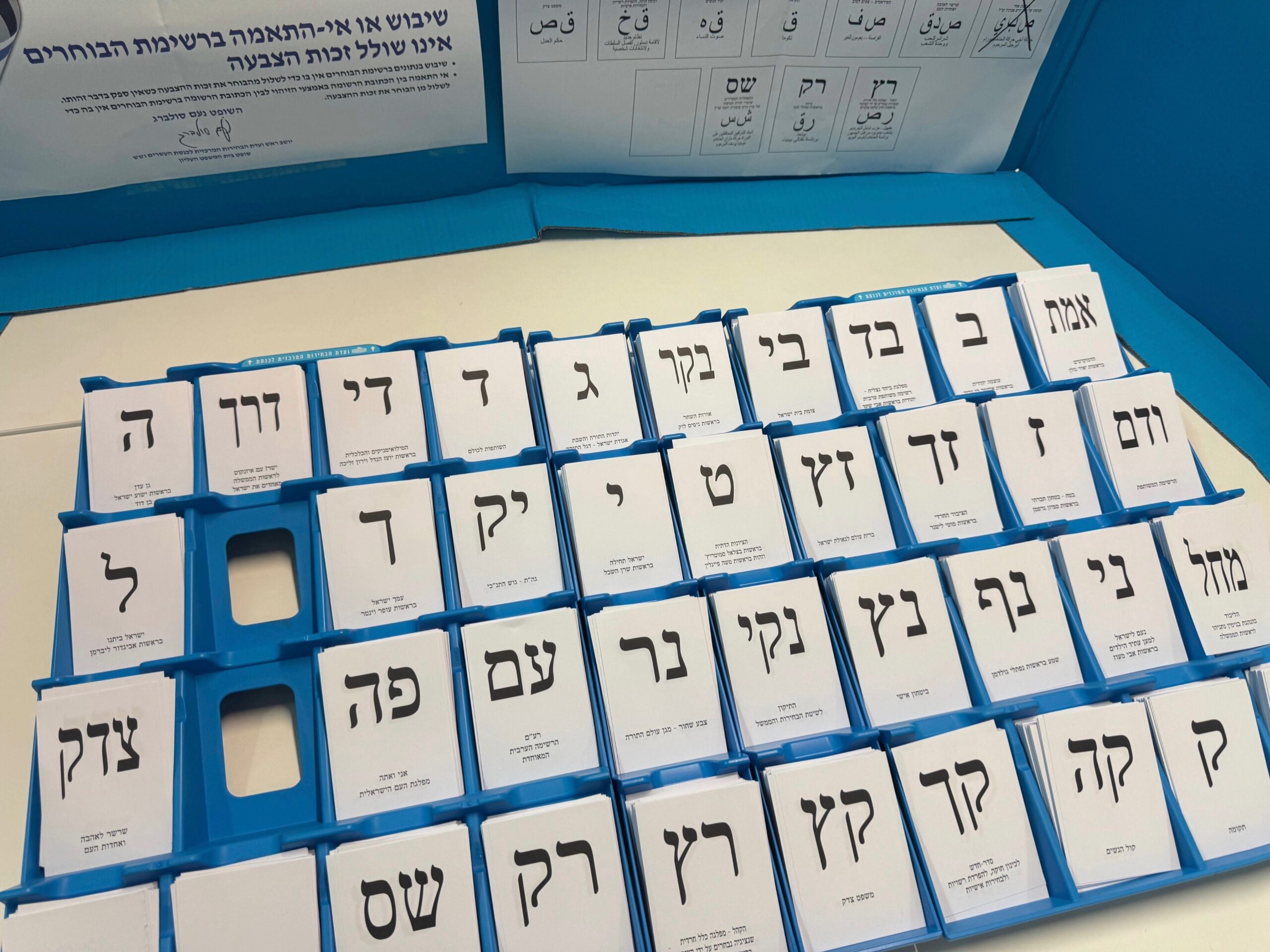
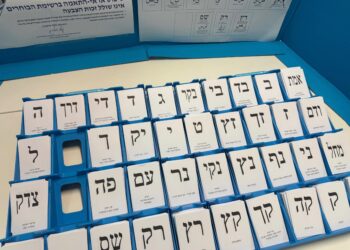
Polls have closed in Israel’s first election since October 7th, 2023. As the votes are being counted and results are coming in, early indications show no clear winner. The official count is still underway, and we expect a much clearer picture by Wednesday (tomorrow).
Benjamin Netanyahu’s Likud is projected as the largest party with 24–25 seats, ahead of Gadi Eisenkot’s Yashar! at 21–23. The bloc opposed to Netanyahu edges his bloc, 52–53 seats to 50, but neither side reaches the 61 seats needed to form a government. Arab parties surge to a projected 17–18 seats. Channel 14’s exit poll is the outlier, giving Netanyahu’s bloc 60. However, both sides show deadlock with no clear winner. Ofer Winter’s Amcha Israel (People of Israel) and Yoaz Hendel’s Reservists’ Party did not meet the 3.25% threshold, meaning they will not be in the next Knesset.
The streets are stressed and a lot of people are feeling tired and worn out.
Soldiers also voted in big numbers, too. IDF turnout hit 68 percent by 5 p.m., up from 65 percent in the last election.
High numbers also mean long lines. Likud asked the Central Elections Committee to extend voting past 10 p.m. Shas, Otzma Yehudit and Ofer Winter’s Amcha Yisrael joined the request, and Gadi Eisenkot’s Yashar party opposed it. The committee rejected the appeal, and polls closed at 10 p.m. as scheduled, but anyone who was already standing in line by then still got to vote.
Of course, the day did not come without controversy. Naftali Bennett’s Beyachad party filed a complaint accusing Likud representatives of tracking voters inside polling stations through a smartphone app. The Central Elections Committee said it had received no reports to back up the claim, and Likud denied it. Beyachad party then filed a second complaint about the app being used at a moshav or a community in the Lower Galilee.
Amcha Yisrael and Yoaz Hendel’s Reservists party also filed complaints over missing and defaced ballot slips. Likud says it logged hundreds of irregularities at polling stations in Arab towns, including alleged leaks of voter information. Prime Minister Benjamin Netanyahu accused Arab parties of trying to steal the election, with more than 620 cases reported to Likud’s elections investigative committee. Eisenkot’s party says Likud is laying the groundwork to challenge the results.
Meanwhile, a civilian election watchdog says it got reports from more than 300 polling stations of people counting or filming voters. At least 100 of them were identified as Likud representatives. The committee says it has found no sign of systematic tampering and is handling complaints one by one. Security was very, very tight.
After last week’s shooting attack near Hebron, the IDF imposed closures on several towns in the West Bank or Judea and Samaria – however you call it as a security precaution. Troops along the security barrier stayed in place over fears of terror attacks, and extra forces were deployed to hiking sites in the area. Overnight Monday, police arrested three residents of Bedouin communities in the Negev on suspicion of election bribery. Police say they found envelopes of cash allegedly meant to pay people to vote for the Arab party Ra’am. Ra’am calls the arrests politically motivated.
In Tel Aviv, police detained a man carrying a knife after he approached the Democrats leader Yair Golan at an Election Day get-out-the-vote event at Park HaMesila. Golan’s party called it an attempted stabbing. Police say the man did not threaten Golan at any point. In the end, nobody was hurt.
In Haifa, Channel 14 reporter Gal Tobi was verbally harassed while covering voting at a polling station. She says a man got close, touched her equipment and interrupted her broadcast, claiming she was filming people in the background. She says he then told his friends, “We don’t want Channel 14.” Tobi says the incident brought her to tears, and that other people at the polling station stepped in to defend her.
An estimated 67,000 Israelis living abroad flew home to vote today in israel – including famous actress Gal Gadot who released a video of herself talking about hoping for change. Israel doesn’t allow absentee voting, so if you want your voice heard, you have to physically be here.
That could also mean a real boost for the economy. One projection puts total travel-related spending at around 600 million shekels, about 182 million dollars. Roughly 268 million shekels of that would be spent right here in Israel on hotels, restaurants, shopping and getting around. Those are estimates, not official forecasts, and some of those visitors might have come to Israel anyway. But it’s a notable short-term bump in consumer spending especially after so many years of tourism taking a hit in Israel.
Throughout the day, the Israel Daily News hit the streets of Tel Aviv and spoke with people right after they voted. Even here, in what many people think of as one city with one political view, we got every kind of answer. Some Tel Avivians voted Yair Golan. Some voted Eisenkot. Some voted Bennett. One we spoke with voted Bibi. Two people we spoke with via phone voted Smotrich. And two voted for Moshe Feiglin.
It’s a real mixed bag.
“It dawned on me earlier today how lucky we are that we can go and make self-sovereignty decisions in a Jewish state in 2026. That I get to be part of that and live in that era, I think is very exciting.” said Jordin, an American olah (immigrant) from Florida, who voted for Likud (Netanyahu).
“I thought about it and I think that Bibi is as flawed as a politician could and will be. For me, the biggest thing for me with Bibi is that there should be an investigation into October 7th and responsibility for that. But at the end of the day, I really feel like that’s a shared responsibility and it’s probably unrealistic to pin that on one person. I am convinced that he’s the best choice to perform on a global stage. The partnership with the United States is really important and that’s his and I don’t believe that there’s another candidate that would be able to manifest that.” she continued.
People who used to vote left told us they’re voting right this time, and people who used to vote right are going left. People want change – following 18 years of Netanyahu.
“We must have a change and we must have people who see the benefits of the citizens and see the benefits of the state of Israel and not themselves.” said Noa, an Israeli living in Tel Aviv.
However, one theme kept coming up: people want an official investigation into what went wrong on October 7th, and many resent Prime Minister Netanyahu for not having one. Even voters of his.
The Israel Daily News also spoke to Nidal, an Arab Muslim living in Jaffa. “This isn’t about white, black, purple or green skin. It doesnt matter about religion. It’s about being a person.” he told us. He also said that if Bibi wins again, he’s leaving the country because he thinks Bibi is mongering war. He also had a small child at home and another on the way, and he doesn’t want to keep rushing them in and out of the shelter.
Nidal’s family has lived in Akko and Jaffa for 120 years, originally coming from Syria and Lebanon, before the borders were drawn as we know it today. He told us he voted for Eisenkot sincerely hoping that war won’t break out again and that Israelis of all backgrounds and faiths will start to love one another without harboring discrimination and hate in the back of their minds and hearts.
















Discussion about this post