

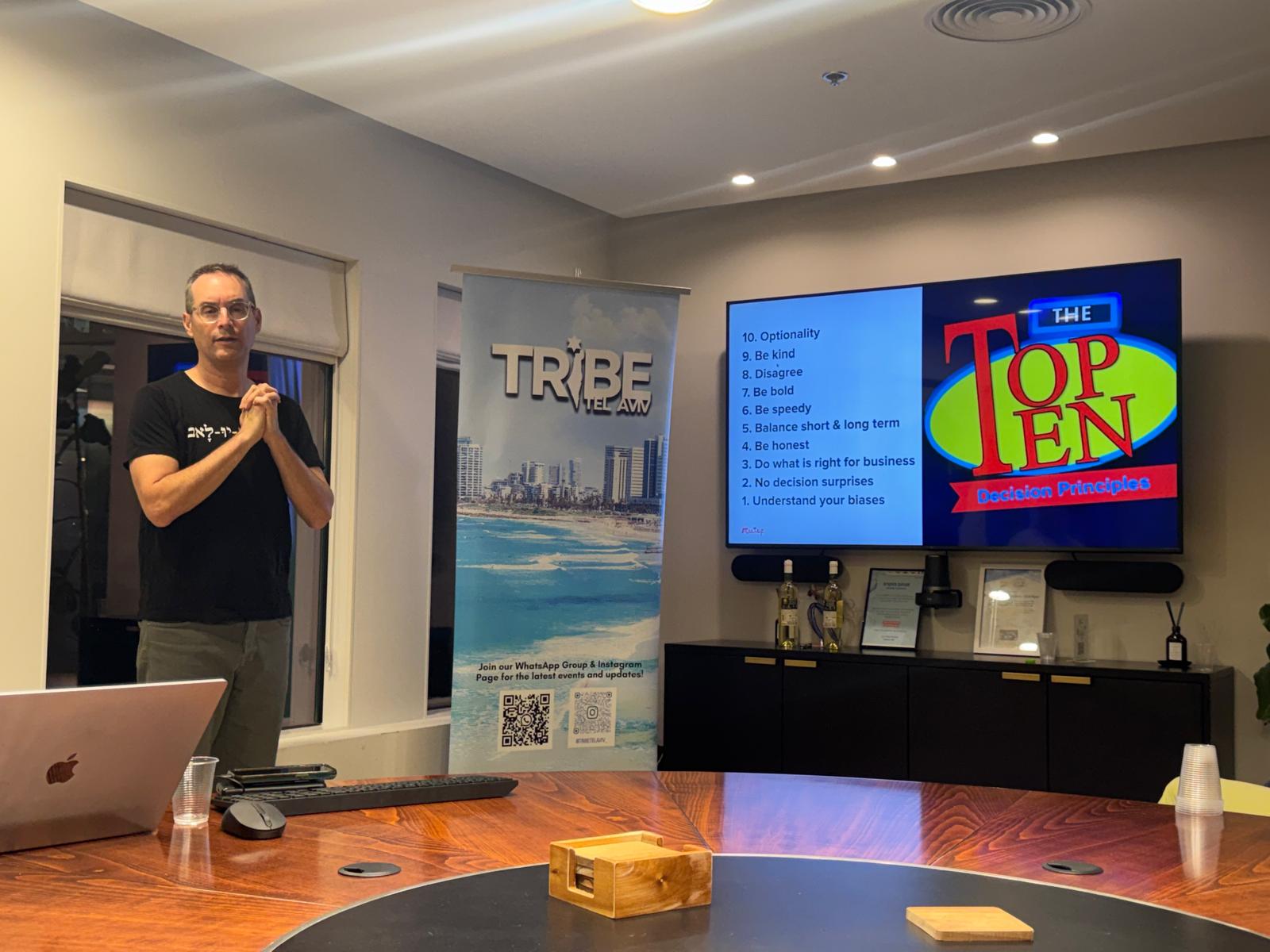
Former Meetup CEO David Siegel shared lessons from his experience in business leadership, entrepreneurship and career development at Tribe Tel Aviv’s Sunset Series Business Forum, offering practical advice on making decisions, building trust and knowing when a business is ready to grow.
The event was hosted and emceed by Shanna Fuld, host and founder of Israel Daily News, alongside Rabbi Jonathan Feldman, director of Tribe Tel Aviv. Through a speech followed by a question-and-answer session, Siegel addressed challenges faced by entrepreneurs, managers and professionals navigating major decisions in their work and personal lives.
Trust and Transparency as Foundations of Leadership
Siegel emphasized that building trust, honesty and transparency are essential to building a strong professional reputation, and encouraged attendees to prioritize what is best for their businesses rather than making decisions for personal gain.
He also highlighted the importance of effective communication, particularly when decisions affect employees, colleagues, family members or friends, and discouraged surprising employees. Communicating openly can help maintain relationships and prevent unnecessary misunderstandings. Another key lesson was the importance of recognizing cognitive biases that can influence judgment.
Siegel discussed recency bias, the tendency to give disproportionate weight to the most recent events or experiences, and confirmation bias, which occurs when people favor information that reinforces what they already believe. He also addressed status quo bias, or the tendency to maintain the status quo, even if it is outdated or no longer relevant.
The sunk cost fallacy was another topic of discussion, and encouraged attendees to recognize when time, money or effort has already been spent and cannot be recovered, rather than allowing past investments to dictate future decisions.
Knowing When to Trust Your Judgment
During the Q&A session that followed the discussion, attendees asked how leaders can determine when they have gathered enough information to make a major decision.
Drawing on his experience acquiring approximately 30 companies, Siegel discussed the distinction between knowledge and wisdom. While knowledge provides information, wisdom combines that knowledge with life experience.
He explained that due diligence is important, but decisions rarely come with complete certainty. At some point, leaders must assess what they know, evaluate the risks and trust their judgment.
Siegel also addressed the role of delegation. When a leader does not know the answer, relying on someone with relevant expertise can help move a decision forward. However, that approach depends on trust in the person making the recommendation.
Reducing Decision Fatigue
The discussion also explored why some people find major decisions difficult, even when they can manage smaller everyday choices.
Siegel spoke about decision fatigue and the value of creating routines that reduce the number of decisions people must make throughout the day. He shared his own approach of keeping his mornings consistent rather than making numerous choices at the start of each day, and establishing habits can help preserve mental energy for decisions that require more attention and consideration.
Networking Starts With Genuine Curiosity
When asked whether networking meetups should focus on specific topics, Siegel emphasized the importance of genuine curiosity over rigid categories.
Meaningful conversations do not have to begin with shared professional interests. Asking someone about their background, experiences or journey to Israel can open the door to a more engaging discussion than simply focusing on technology or industry-specific subjects.
Siegel described the process as finding the topic that genuinely interests the other person. He noted that people often want to feel understood and discover that others share similar experiences.
The takeaway for professionals attending networking events was straightforward: building connections starts with being genuinely interested in the people around you.
Knowing When to Change Jobs
Siegel also shared lessons from his own career, during which he held eight jobs. His longest tenure was five and a half years, while his shortest was one year.
Rather than advising people to leave a job as soon as they stop learning, Siegel challenged the idea that professional growth alone should determine when someone moves on. There is almost always more to learn, he noted.
Instead, he encouraged professionals to identify what is making them unhappy and consider whether changes to their responsibilities or working arrangements could improve the situation, and suggested having open conversations with managers about wanting to change the day-to-day nature of a role before deciding to leave. If a difficult manager is the primary problem, seeking a different reporting structure or team may be worth exploring.
Siegel also emphasized the importance of leaving a job under good conditions whenever possible. For him, one warning sign was beginning to become a person he did not want to be, particularly when dissatisfaction led him to speak negatively about his workplace.
Maintaining personal integrity and being able to respect oneself, he suggested, should be part of the decision about when to move on.
Why Businesses Should Not Rush to Scale
For entrepreneurs, Siegel warned against expanding a business before it is ready. The pressure founders can face to demonstrate growth, whether from managers, external expectations or the perception that a larger business is automatically a more successful one, can push companies to scale before they have established product-market fit.
Growing too quickly can lead businesses to waste time and money on expansion before they have confirmed that customers genuinely want what they are offering.
Identifying customer recommendations and referrals are important indicators of product-market fit. He pointed to net promoter score (NPS), a measure of how likely customers are to recommend a product or service, as one useful tool for assessing customer satisfaction and loyalty.
Ultimately, he stressed that businesses should pay attention to what their customers are actually doing. If customers are not recommending a product or service to others, that may indicate that the business needs to address underlying problems before investing in further growth.
Family and the Decision to Move to Israel
The conversation also highlighted Siegel’s decision to move to Israel.
He explained that the move was driven primarily by family. With three of his children already in Israel, family became the deciding factor, even though the transition was not easy.
Siegel recalled choosing the name Yair for his first son, partly with the hope that his son would one day feel comfortable living in Israel. Years later, he described how his children’s decisions to live in Israel ultimately influenced his own move.
His experience added a personal dimension to the discussion, illustrating how major life decisions can be shaped by priorities that extend beyond professional opportunities or convenience.
A Forum on Business and Personal Growth
Tribe Tel Aviv’s Sunset Series Business Forum provided an opportunity for professionals to discuss leadership, entrepreneurship, career decisions and the challenges of building meaningful connections.
Across the conversation, Siegel returned to several recurring themes: communicate honestly, recognize the biases that shape decisions, know when to stop investing in an approach that is not working, and avoid allowing external pressure to dictate the pace of business growth.
His advice underscored the importance of combining data and experience with self-awareness, sound judgment and a clear understanding of personal priorities.



















Discussion about this post