

Yiddish, a thousand-year-old language that served, for centuries, as the mother tongue of Ashkenazi Jews in Eastern Europe, is endangered. The Holocaust, alongside generations of assimilation, contributed to a steep decline in the number of people who speak Yiddish. However, despite its loss of popularity, students from all over the world gather every summer at Tel Aviv University to learn, speak, and embrace Yiddish, a language integral to the past, present, and future of the Jewish people. And if you don’t believe that it’s a part of Israel’s future, you need to read on.
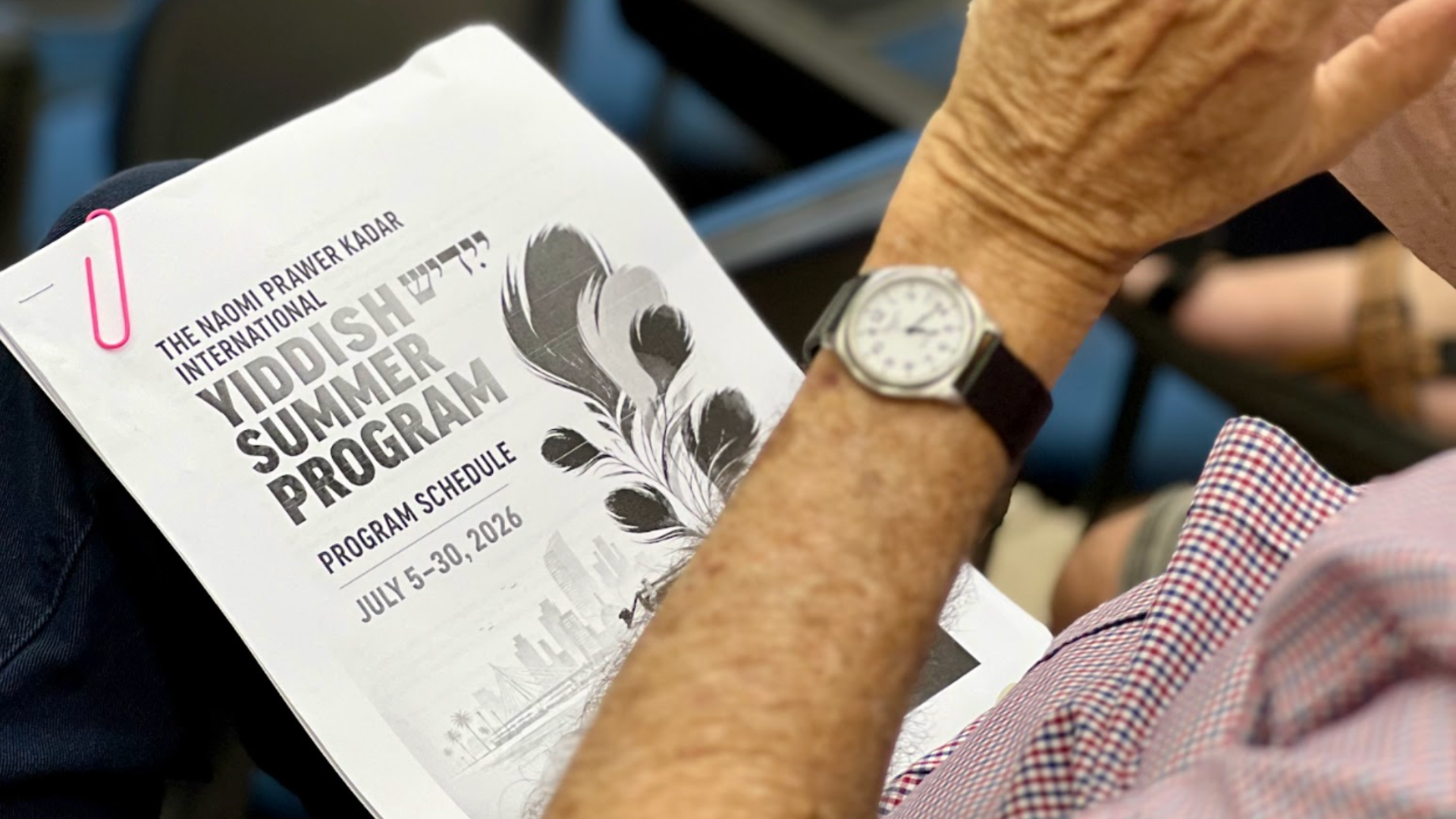
The Naomi Prawer Kadar International Yiddish Summer Program fosters a cohort of people of all ages who are eager to learn and study Yiddish. During the four-week intensive program, students can enroll in one of four levels of in-person Yiddish classes, attend lectures on the history and importance of the language, and experience daily opportunities for immersion both inside and outside of the classroom. At the end of the program, students receive academic credit, providing them with the opportunity to advance their degree via the study of a language that might not be offered at their home universities.
Dr. Justin Cammy, Dean of Faculty and Professor of Jewish Studies and Comparative Literature at Smith College, has spent the past 16 summers teaching students in this summer program. He explained that the primary goal of this seminar is to bring together students from around the world and teach them the language itself. However, the secondary goal is to “provide them with an unsentimental non-sacred version of Yiddish.”
The program seeks to challenge many of the assumptions commonly associated with the language.
“Yiddish being old…actually Yiddish is young. Yiddish being dead… well actually the number of Yiddish speakers is rising. Yiddish being diasporous, actually Yiddish always played a role in the land of Israel. Yiddish being radical or revolutionary, actually Yiddish also has a very long history of traditionalism. Yiddish being anti-Zionist… actually it’s not only diasporous,” Cammy explained.
The students in the program are diverse in age, nationality, educational background, and most notably, motivation for participating. Some students want to learn Yiddish to enhance their research capabilities, while others come from an Ashkenazi family and want to better understand the language of their ancestors. Whatever their motivation, they are united by a collective desire to deeply engage with and preserve Yiddish.
The program is not only important because it educates students about Yiddish, but also because it represents that this language, which many view as “dying,” is alive and well. In fact, those involved in the program argue that learning Yiddish is now more important than ever.
Program director Dr. Rachel Wamsley explained that Yiddish remains integral to the Jewish people and the world at large.
“We’re all looking for powerful ways to frame what is happening in this moment in Jewish history,” Wamsley said. “Yiddish provides us with an incredibly rich, diverse, conflictual, and varied account of what Jewish identity means.”
Dr. Cammy shared that “Even the history of Zionism can’t be written without some knowledge of Yiddish.”
So much of Jewish history’s texts, documents, debates, books and much of Israel’s early cultural and intellectual history were shaped in the language. Translations are simply not enough to truly pull out the essence. His comment highlights how the language is essential to understand literature, theater, music, and anthropology that shaped Jewish life before the establishment of the state.
Although Yiddish is often associated with the Jewish past, Wamsley explained that it just as much serves as a window into what lies ahead. She expanded on this idea, sharing that “Yiddish literature, culture, music, religious practice, and community offer one of the most powerful witnesses to what we are now and what we’re going to do in the years to come.”
By learning Yiddish, the students of this program are doing more than preserving a piece of Jewish history; they are helping to build the Jewish future.














Discussion about this post