

With less than two months to go until Israel’s legislative elections, another right-wing party has entered the race. Amcha Israel (“People of Israel”) is the newest party seeking to challenge Likud and reshape Israel’s political right.
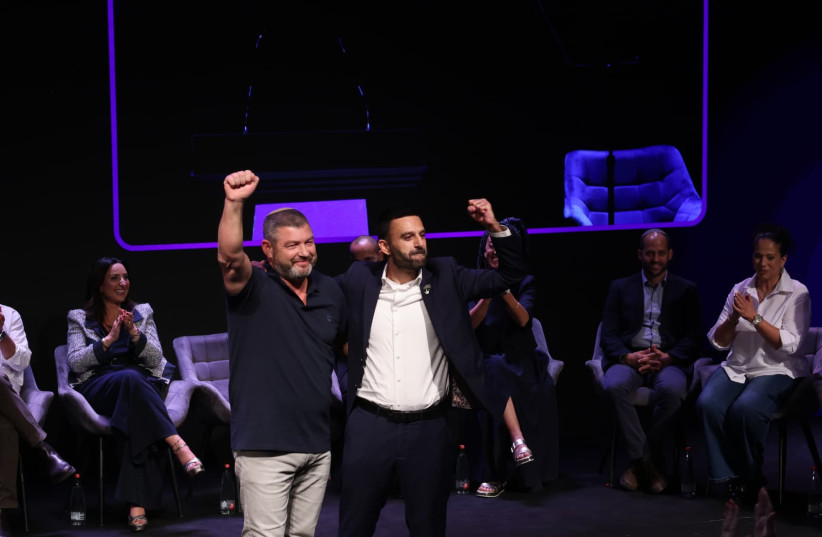
Headed by controversial former IDF general Ofer Winter, Amcha Israel is campaigning on a hard-line security platform while presenting itself as a movement capable of bringing together Israelis from different sectors of society. The party officially launched Tuesday night (August 25) in Jerusalem with roughly 300 supporters in attendance.
At the center of Amcha Israel’s platform is a significantly more aggressive security doctrine. The party opposes the establishment of a Palestinian state, supports Palestinian emigration from Gaza and advocates for the integration of Haredi (ultra-Orthodox) men into the IDF.
Winter, who previously commanded the IDF’s Givati Brigade, argues that Israel must abandon what he sees as the failed pre–October 7 strategy of containment. Instead of allowing threats along Israel’s borders to develop until they become immediate dangers, he says Israel should act proactively to eliminate them.
Winter has also argued that protecting Israeli soldiers during combat should take precedence over protecting enemy civilians, framing this as part of a broader reassessment of Israel’s security doctrine after October 7.
Beyond security, Amcha Israel is emphasizing what it sees as a need to more clearly reward Israelis who contribute to the state through military or national service. Winter has called for greater recognition and benefits for those who serve, and the party’s slate includes reservist activists who have advocated for additional benefits in areas including education and the civil service.
Winter has described the upcoming election as a “referendum on whether we are capable of handling the real challenges of the State of Israel” — among them integrating Haredim into the IDF, connecting with Arab Israelis who support the state, reforming the judicial system, and combating protection rackets and violent crime “from the Negev to the Galilee.” The latter has become an increasingly prominent political issue amid persistent violence within Arab Israeli communities.
Despite his strong messaging, Winter enters politics with a decade-long history of controversy.
During the 2014 Gaza war, while commanding the Givati Brigade, Winter drew criticism over a letter to his subordinate officers that invoked religious language and described Israel’s enemy as a “blasphemous foe.” He was later accused of passing sensitive information about the military campaign to then-Economy Minister Naftali Bennett outside the normal military chain of command. Winter’s military career ultimately ended in 2024 after he was repeatedly passed over for promotion and released from the IDF.
Two of the most prominent candidates on the Amcha Israel slate are Yoseph Haddad and Fleur Hassan-Nahoum.
Yoseph Haddad is an Arab-Israeli Orthodox Christian and one of Israel’s best-known public-diplomacy personalities. He holds the No. 2 spot on the party list. His inclusion reflects Winter’s stated interest in building ties with Arab Israelis who, in his words, “want the good of the country.” Haddad has long promoted Jewish-Arab partnership within Israel while fiercely opposing anti-Israel political movements and narratives. Winter has even floated Haddad as a potential future minister responsible for Israeli public diplomacy.
Fleur Hassan-Nahoum is the former Deputy Mayor of Jerusalem and former Israeli special envoy for trade and innovation. Currently, she is the host of “The Quad,” on JNS (Jerusalem News Syndicate) TV. She is a lawyer by profession and social entrepreneur. She immigrated to Israel 25 years ago from Gibraltar, where she grew up, and is the daughter of Sir Joshua Hassan, the first mayor and Chief Minister of Gibraltar. Hassan-Nahoum speaks English, Hebrew and Spanish.
The inclusion of Hassan-Nahoum adds an established political and international-affairs voice to a slate otherwise heavily shaped by the post–October 7 security environment.
“Since making Aliyah in 2001, I have dedicated my life to serving Israel and the Jewish people – as a Jerusalem City Councilor and Deputy Mayor, Israel’s Special Envoy for Innovation, strengthening ties with our Gulf neighbors and promoting women’s leadership,” Hassan-Nahoum said in an Instagram post..
“Since October 7, I have worked to represent Israel around the world. That terrible day and the years since have made one thing clear: Israel needs a new generation of leadership,” wrote.
“We will work for equal responsibility in national service, a strategy to defeat our enemies on all fronts, the successful absorption and representation of Olim, and stronger ties with our brothers and sisters in the Diaspora,” she said.
Judicial reform is another key issue in the party’s agenda. The party supports changes to Israel’s judicial system, and candidate Eran Ben-Ari has characterized Amcha Israel’s approach as a more focused reform intended to rebalance the branches of government, increase transparency and strengthen governability.
Domestic security is another central issue. Winter has repeatedly highlighted violent crime and protection rackets stretching from the Negev to the Galilee, arguing that the Israeli government must respond far more aggressively.
At the same time, Winter has sought to frame Amcha Israel around a broader cultural message centered on Eretz Yisrael, Am Yisrael and Jewish tradition. He argues that Jewish tradition should be strengthened “not through coercion, [but] through love,” and has characterized Judaism as a family rather than another political battleground. However, he is not attempting to position himself as a centrist, and has explicitly identified Amcha Israel with Israel’s right-wing camp and has said he wants the broadest possible right-wing government composed of Zionist partners.
What makes Amcha Israel particularly interesting is that it is not presenting itself simply as another religious-right party. Its candidate list is constructed around the political and social realities that emerged after October 7: military officers and reservists, members of bereaved families, residents of the Gaza border communities, public-diplomacy figures, Sephardi and traditional Jewish voices, and, through Haddad, a prominent Arab Israeli Zionist voice. That combination allows Winter to pitch Amcha Israel as both ideologically right-wing and socially broader than some of the parties traditionally associated with Israel’s religious right.
In addition to Ofer Winter, Yoseph Haddad, and Fleur Hassan-Nahoum, their candidates also include:
– Lali Derai, mother of fallen reservist Staff Sgt. Maj. Sa’adya Yaakov Derai, who fell in battle in the Gaza Strip. Since the loss of her son, Derai has become a prominent and leading voice in Israeli society. She is at the forefront of the public debate over military conscription, works to strengthen Sephardic empowerment and identity, and dedicates her time to spreading messages of unity, mutual responsibility, the search for meaning and love of Israel.
– Aviv Ezra, a reservist combat soldier who has served hundreds of reserve-duty days since October 7. Ezra heads the “Victory Generation” movement, which has led a series of public initiatives and legislation on behalf of reservists, including measures giving reservists preference in academia and civil service, an amendment to the “From Uniform to Studies” law, the launch of a “Reservist Badge” in the business sector, and efforts to expand the ranks of those serving and establish an effective conscription law. His joining significantly strengthens the representation of the “generation of fighters,” reservists and young people.
– Ronen Bodner, an economist who served as a combat soldier and commander in the elite Egoz Unit, and is a reserve major. served as a deputy battalion commander in the medical unit of Division 98. He rushed to fight on October 7 in some of the most difficult combat zones around the Gaza border and has since served roughly 800 days of reserve duty. Bodner began his professional career as an economist at Rambam Hospital, where he dealt with the healthcare system and health funds. In that role, he negotiated employment and salary conditions across various sectors of the healthcare system and led significant reforms and agreements, including a major agreement during the COVID pandemic regulating nurses’ working hours in capsule shifts, valued at more than NIS 400 million. He has also appeared before various Knesset committees and responded to inquiries from ministers, MKs and media organizations. Today, he works at a private investment company.
– Reserve Lt. Col. Eli Gino, a former commander of the Givati Reconnaissance Battalion and head of the brigade’s reserve staff. He also served as commander of the Givati reconnaissance unit during the incident in which Hadar Goldin, of blessed memory, was abducted during Operation Protective Edge. He later served as deputy commander of the Givati Brigade and deputy commander of the Edom Formation (Division 80). Since his discharge, he has completed more than 1,000 reserve-duty days during the “Swords of Iron” war as chief of staff of the Givati Brigade in various combat sectors.
– Davidi Ben Zion, deputy and acting head of the Samaria Regional Council, and a reserve major in the Paratroopers Brigade, and a graduate of the Maoz program. Ben Zion brings 11 years of municipal and public leadership experience in the Samaria Regional Council, alongside extensive social work and leadership of the nonprofit “Shomron — Naim Lehakir,” which operates protected homes for at-risk youth. As a reservist in Brigade 55 of Division 98, he has served hundreds of reserve-duty days since the outbreak of the war, beginning with the fighting in Kfar Aza on October 7, through Khan Younis and later in the Lebanon and Syria sectors.
– Eran Ben Ari, an attorney and a member of the National Council who leads the opposition within the Israel Bar Association. He previously served in the State Attorney’s Office and Ministry of Defense and is currently a partner at a law firm. Ben Ari, who specializes in Israeli philosophy, previously served as secretary of the committee headed by former Supreme Court Justice Edmund Levy. He is an expert in settlement law and represents national organizations and bereaved families. He also hosts a popular legal podcast in Israel and is a well-known legal commentator in the media.
– Sigal Kranowski-Natiah, the widow of Kibbutz Be’eri security coordinator Arik (Arieh) Kranowski, who was killed on October 7 while defending the kibbutz. Since October 7, Sigal has worked intensively on issues surrounding the captives and hostages taken by terrorists from Kibbutz Be’eri. The person who located his body on the day of the battle was Lt. Col. Ofer Winter, who rushed to fight in Be’eri and the surrounding area. After years devoted to working with children and teenagers, particularly at-risk youth and communities in southern Israel, Sigal has become a public figure advocating for the security of residents of the western Negev and Gaza border communities. She lectures to military, social and business organizations, engages in public diplomacy in Israeli media and promotes a hard-line security policy, including opposition to agreements with Hamas and support for encouraging voluntary emigration from Gaza as part of a broader approach to changing the region’s security reality.
– Netali Shem Tov, a respected news presenter and journalist who is a resident of northern Israel. She and her family were evacuated from their home in Metula when the Swords of Iron war broke out. Throughout her career, and especially during the war, she brought to the screen a distinctive and courageous perspective on the lives of residents and from beyond enemy lines. She has dealt extensively with equal opportunity in Israeli society and strengthening the periphery and border communities. She was chosen to host the 2024 Independence Day torch-lighting ceremony and the 2025 Israel Prize ceremony.
Whether Amcha Israel’s strategy will translate into enough votes to cross Israel’s electoral threshold remains to be seen. But with only two months remaining until Israelis head to the polls, Amcha Israel adds yet another competitor to an increasingly crowded right-wing field, and another challenge for Likud as parties compete to define what Israel’s political right should look like in the post–October 7 era.














Discussion about this post