


Two weeks ago, I arrived in Tzfat thinking I already knew Israel pretty well.
After living here for years, especially in Tel Aviv, I am used to a certain Israeli rhythm: fast, intense, ambitious, always moving. We answer messages while walking, drink our coffee quickly, think about the next meeting, the next opportunity, the next thing we are supposed to accomplish.
And then I arrived in Tzfat.
It almost feels like discovering another part of Israel entirely.
Here, time seems to work differently.
If you order a coffee or a fresh juice, it might take a little longer. At first, coming from the metropolis of Tel Aviv, you notice it. You wonder why everything isn’t moving faster. But then something interesting happens: you stop caring.
You sit. You talk. You look around. You breathe.
And slowly, you realize that maybe there is nothing wrong with taking your time.
And actually, something happened to me just a day ago that perfectly describes the rhythm of Tzfat.
I was walking around when I noticed a place serving matcha. I’m not particularly a matcha person, but I was curious, so I decided to try one.
The man working there looked at me very seriously and said, “Just so you know, it’s going to take some time. At least 15 minutes.”
Fifteen minutes? For a matcha?
Coming from Tel Aviv, I was genuinely surprised. We are so used to ordering something, paying, picking it up and continuing with our day. Fifteen minutes for one drink sounded … absurd.
But then he explained why.
He was going to prepare the almond milk himself, from scratch! Just for this one drink.
Suddenly, those 15 minutes made sense.
This wasn’t about someone being slow or inefficient. It was actually the opposite. He was taking what he was making seriously. He cared about the ingredients, about the process and about giving me something that had been freshly prepared rather than simply opening a carton and pouring it into a cup.
And I realized that this little matcha was almost a metaphor for my entire experience in Tzfat.
I came to Tzfat to spend several weeks studying in a seminary, and I have to admit that the beginning was overwhelming. Tzfat is not a city you understand immediately.
There is something very intense about it—not in the same way Tel Aviv is intense, but spiritually. There are synagogues everywhere, people learning Torah, people praying, people speaking about Chassidut, Kabbalah and Jewish life as part of completely ordinary conversations.
For someone arriving from the center of the country, where religious and secular worlds constantly mix, Tzfat can feel like entering another universe.
But after a few days, I stopped trying to understand everything.
I started accepting its rhythm.
We take time to learn here. We take time to have conversations. We take time to sit over coffee. And perhaps most importantly, we are not constantly made to feel that slowing down means falling behind. That has probably been one of my biggest lessons since arriving.
Tzfat—also known as Safed—is one of Judaism’s Four Holy Cities, alongside Jerusalem, Hebron and Tiberias.
Although Jewish life existed here much earlier, the city entered one of the most extraordinary periods in its history during the 16th century. Following the expulsion of Jews from Spain in 1492 and the Ottoman conquest of the region in the early 16th century, Jewish immigrants—particularly Sephardic Jews—settled in Tzfat. The city developed into a thriving center of commerce, textile production, Torah scholarship and Jewish thought.
By the middle of the 1500s, Tzfat had become one of the most important centers of Jewish intellectual life in the world. This was the Tzfat of Rabbi Yosef Karo, author of the Shulchan Aruch, one of the foundational codes of Jewish law. It was also the Tzfat of Rabbi Moshe Cordovero and, perhaps most famously, Rabbi Yitzchak Luria—the Ari—whose teachings profoundly transformed the study of Kabbalah.
The Ari lived in Tzfat for only a short period, from 1570 until his death in 1572, yet his influence on Jewish mysticism became enormous. Even the Kabbalat Shabbat traditions associated with Tzfat and its Kabbalists continue to shape Jewish communities around the world today. You can enter the Ari Ashkenazi Synagogue. You can visit the synagogue associated with Rabbi Yosef Karo. You can walk through narrow stone passages that generations of rabbis, students, artists and families have walked before you.
History feels alive here. And Then There Is the Art
What surprised me most is how naturally spirituality and creativity coexist here. Tzfat is not only known for Kabbalah and Torah. It also developed one of Israel’s most recognizable artistic communities.
In the early years of the State of Israel, artists were drawn to the city’s atmosphere and established what became the Artists’ Quarter. At its height, dozens of painters and sculptors lived and exhibited here, including important figures in the development of Israeli art.
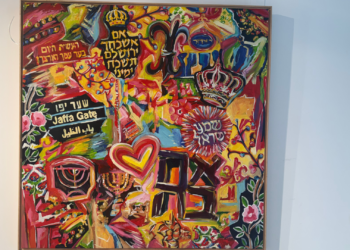
That creative identity is still visible today. Walk through the Old City and you constantly find small galleries and workshops hidden behind stone archways. There are paintings inspired by Jerusalem, Kabbalah, Hebrew letters and Jewish symbolism, but also contemporary pieces, jewelry, ceramics and Judaica. As someone who paints myself, I find this part of Tzfat particularly beautiful.
Art here doesn’t always seem separated from religious life. Sometimes the two become part of the same conversation: How do you take something internal—an emotion, a belief, an idea—and give it a physical form?
Tzfat is also a real city, however. It has its own imperfections. And if you come here, be prepared to walk.
A lot.
Tzfat sits high in the mountains of the Upper Galilee, and exploring the Old City means constantly going up and down hills and staircases. Google Maps doesn’t always prepare you for what “five minutes away” can mean when those five minutes involve what feels like 200 stairs.
But that is also part of its charm.
Behind one staircase you discover a synagogue. Behind another, a tiny gallery. Then a courtyard. Then a coffee shop. The coffee shops here have become some of my favorite places to observe the city’s rhythm. They are generally small and intimate, and somehow having coffee in Tzfat feels different from having coffee in Tel Aviv.
In Tel Aviv, coffee can be something you grab between two things.
Here, coffee can be the thing.
You sit.
And apparently, that’s allowed.
I think this is ultimately what Tzfat has been teaching me.
We spend so much of our lives thinking about progress. What are we doing next? Where are we going? What are we building? What should we have accomplished by now?
Instead of What’s next?, perhaps the question here is sometimes simply: Where are you right now?
Tzfat is small. It is hilly. It can be confusing. It can be overwhelming. Things don’t necessarily happen when or as quickly as you expect them to.
And yet, after two weeks here, I am beginning to understand that this may be precisely the point.
Sometimes slowing down doesn’t mean that nothing is happening.
Sometimes slowing down is when you finally have enough space to notice what is happening inside you.



















Discussion about this post