

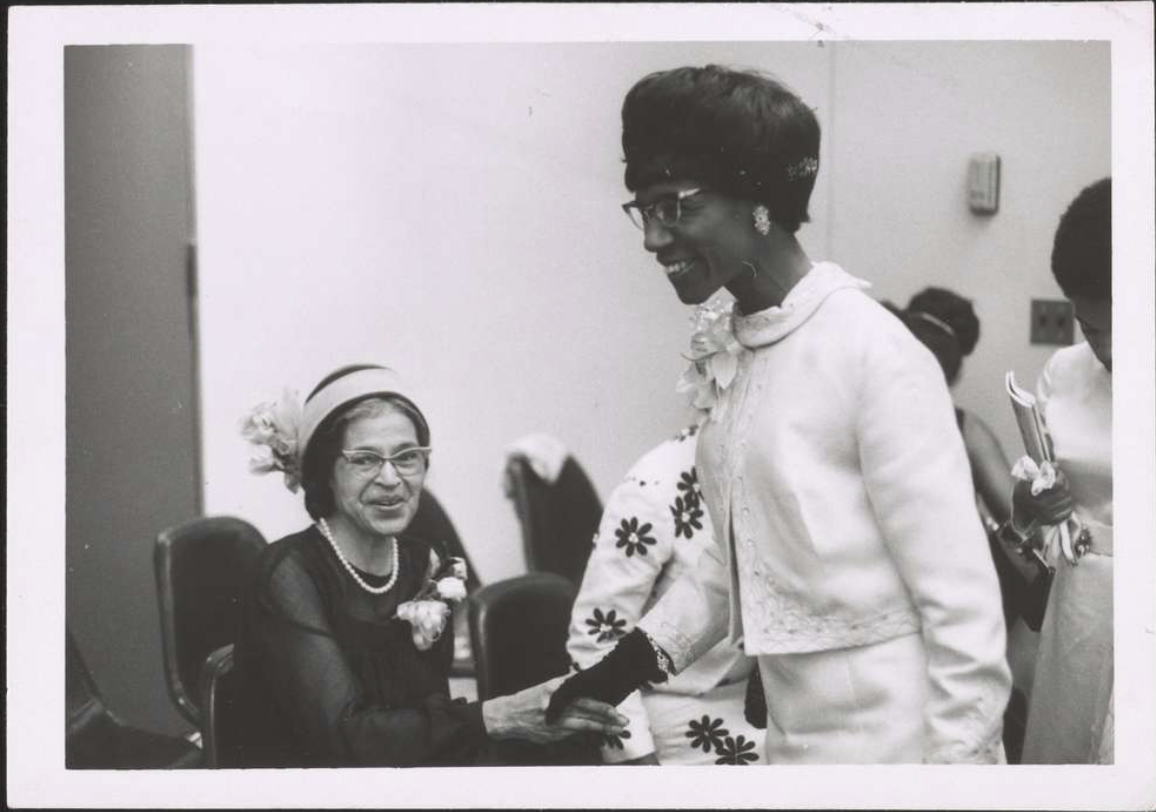
Shirley Chisholm didn’t look like a star. She had large shining white teeth, dark skin and no-nonsense metal eyeglasses. When she spoke, all you could hear was truth.
Her father worked as a laborer in Guyana, a small country in South America. Her mother was from Barbados, in the Caribbean, and was a seamstress. They had three daughters under the age of 5. Shirley was the oldest. Parents from Barbados had two goals: to buy a home for their family and to have their children get a college education. Saving money to buy a house with little children who needed total care at home was impossible. Her parents decided to send Shirley and her two sisters to live on her grandmother’s farm in Barbados. Shirley was just 5 years old. Little did young Shirley realize that she was doing what thousands of immigrants did, only in reverse. Immigrants from all over the world were coming to America by sea to find a new home. Shirley, her mother, and sisters went by ship on a nine-day voyage to Barbados. Shirley’s mother stayed for six months to help her children get used to living there with their grandmother. Mrs. Emily Seale was tall and had a powerful voice. Shirley never disobeyed her grandmother. Mrs. Seale gave her granddaughter, Shirley, love and a feeling of self-confidence. “I learned from a young age that I was a somebody,” Chisholm said.
Her strict British school had one room with 125 children from all ages. There were seven classes with dividers between them. Despite the chaos, Shirley learned to read and write by the time she was five. They went to school from 8 to 4 and then got right to their chores on the farm. The Chisolms fed the ducks, chickens, cows, sheep, gathered eggs, and brought back water. Pail by pail, the drinking water came from a well. She learned to give the animals a drink. The rest of the water went into a big tub for drinking, cooking, and washing. When night came the moos of the cows and the clucking of the chicken kept the city children awake. They walked everywhere barefoot. Their favorite place was swimming in the Caribbean Sea.
Shirley was a voracious reader. The kids would laugh at her when she walked home with five or six books. Seven years later Shirley moved back to Brooklyn. It was very hard to get used to the cold weather and how big the city was. After elementary school, Shirley went to an all-girls high school that helped her prepare for college. She lived in one of the poorest parts of New York City. Two prestigious colleges wanted to give her scholarships, but her family could not afford the rest of the expenses, so Shirley decided to attend Brooklyn College, a free and public University. She studied education to become a teacher.
Shirley joined the debate team, where she would learn to argue different sides of an idea. She won awards for how well she presented her side. A blind professor whom Shirley nicknamed “Proffy,” told her she should become a politician. Shirley told him that there were two things against her going into politics: that she was black and she was a woman.
Shirley graduated with honors at age 22. She wanted to be a nursery school teacher. One problem: She looked like she was 16 years old and weighed only 90 pounds. No one believed she could teach. After many interviews, Shirley yelled out, “Give me a chance, try me out for a while!” She got hired and worked at the school for seven years.
Shirley went on to get married and went back to school, getting a Master’s Degree in Early Childhood Education. She became the director of a large day care program with 130 students and more than 30 staff in New York City.
Shirley lived at a time when there was very little equality between whites and blacks in New York. At the university, she started to feel angry about how black people were treated. She got active in organizations to change that. Over the next few years, all of her talents and interests showed she was ready for the next step: Becoming a leader to help people improve their lives.
Shirley still had doubts. Should she risk everything to become a leader? Could she succeed at being a black female politician?
One day someone knocked on her door. An old black woman with a cane was standing there. In her hand was an old, wrinkled envelope. “Miss Shirley, we heard you were going to try to become our Congresslady, and we neighbors collected this here money for you!” When Shirley opened the envelope, there was $9.34. A very small amount, but it gave her an answer: Yes, go be a politician.
In the 1960’s there were no black women in leadership roles. Shirley would change that.
It was 1968. Out of 435 members in the House of Representatives, there were only six women — and none were black! No black woman had ever been elected to Congress. Shirley wanted to be a leader for the people. The incumbent black man in the role called Shirley a “A little schoolteacher.” He thought she wasn’t strong enough for the job. Shirley’s husband, however, cheered for her. He said “SHIRLEY is 100 POUNDS OF NUCLEAR ENERGY!”
Shirley drove a truck to big apartment buildings in Brooklyn and using a loudspeaker, roared, “Ladies and gentlemen, this is Fighting Shirley Chisholm coming through!”
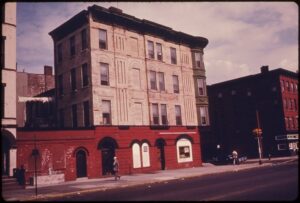
What did Shirley do? She needed votes to win. First, she found out there were two times more women than men in Brooklyn, and for every 10 women, two were from Puerto Rico. Shirley had learned Spanish when she was in college. She spoke to the Puerto Rican women in Spanish. “Escuchame,” (Listen to me!) said Shirley. And they did. Shirley was popular because her family was from the Caribbean islands and so were many people in Brooklyn. The related to her. She ate bagels and lox with the Jewish women in Crown Heights. They listened and related to her too.
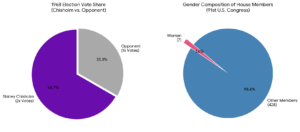
When the election results came in, Shirley Chisholm had won and she won big. She received two times as many votes as her opponent! She became the first woman of color to be a congresswoman. She was one of only seven women in Congress out of 435 members!
“If they won’t give you a place at the table, bring a folding chair,” said Shirley Chisholm.
The older Southern congressmen did not want to share their power with her and they had the power to choose where a newcomer could work. They put Shirley on the least important committee: the Agriculture Committee. What is Agriculture and Forestry? Farms and Farm Animals, Forests? How many farms and forests are in Brooklyn? None!
Shirley was disappointed. How could she help the people who sent her to Congress while being on the Agriculture Committee? She gave interviews about her feeling to the newspapers. Then the phone rang.
The call came from the secretary of the Lubavitcher Rebbe (Rabbi), a Jewish leader and teacher. His office was in Crown Heights, Brooklyn. That was Shirley’s neighborhood. “The Rebbe would like to see you,” the secretary said. Shirley came to the his office at 770 Eastern Parkway.
In the center of his office was a large, old brown wooden desk completely empty except for a blotter.
The whole office was very simple. Brown wooden paneling, a standing gray file cabinet and books on many shelves.
The Rebbe had a full black beard, black hat, long black coat and kind blue eyes. He welcomed her in. “Congratulations on your new job in Congress!” said the Rebbe, speaking in English with a European accent.
“Thank you,” Shirley said, “but being on the Agriculture Committee is not where I thought I would be. I am very disappointed and insulted. How can I help people who voted for me?”
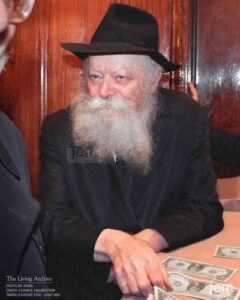
The Rebbe said, “I know you are upset. Yet G-d has given you a blessing and opportunity to be on this very committee. You know the farmers in America are growing more food than they can sell. They need to find new places to sell their surplus crops. You will find a creative way to take that extra food to feed poor people. You will be able to make a difference.”
On her first day in Washington, D.C., Shirley happened to meet Senator Bob Dole, from Kansas. The state of Kansas is mostly farmland. Dole wanted to help farmers who had extra food to sell, but no one wanted to buy it. Farmers were even throwing away food because they couldn’t sell it and make any money. Shirley thought, this is what the Rebbe told me about. Shirley and Bob Dole worked together and made the Food Stamp Program much bigger where poor people can buy food at low prices. It helped the farmers and helped the poor people.
Later they made another program called WIC (Women, Infants and Children) that helped mothers, babies and children get free food. Today WIC helps more than 8 million people every month!

Shirley went on to make important laws for the next seven terms. That’s 14 years in Congress. When she decided to retire, she said, “I owe all of this to a rabbi who was an optimist, who taught me that what you think is a challenge, is actually a gift from G-d. And if poor babies have milk, and poor children have food today, it’s because this rabbi in Crown Heights had vision.”




















Discussion about this post