

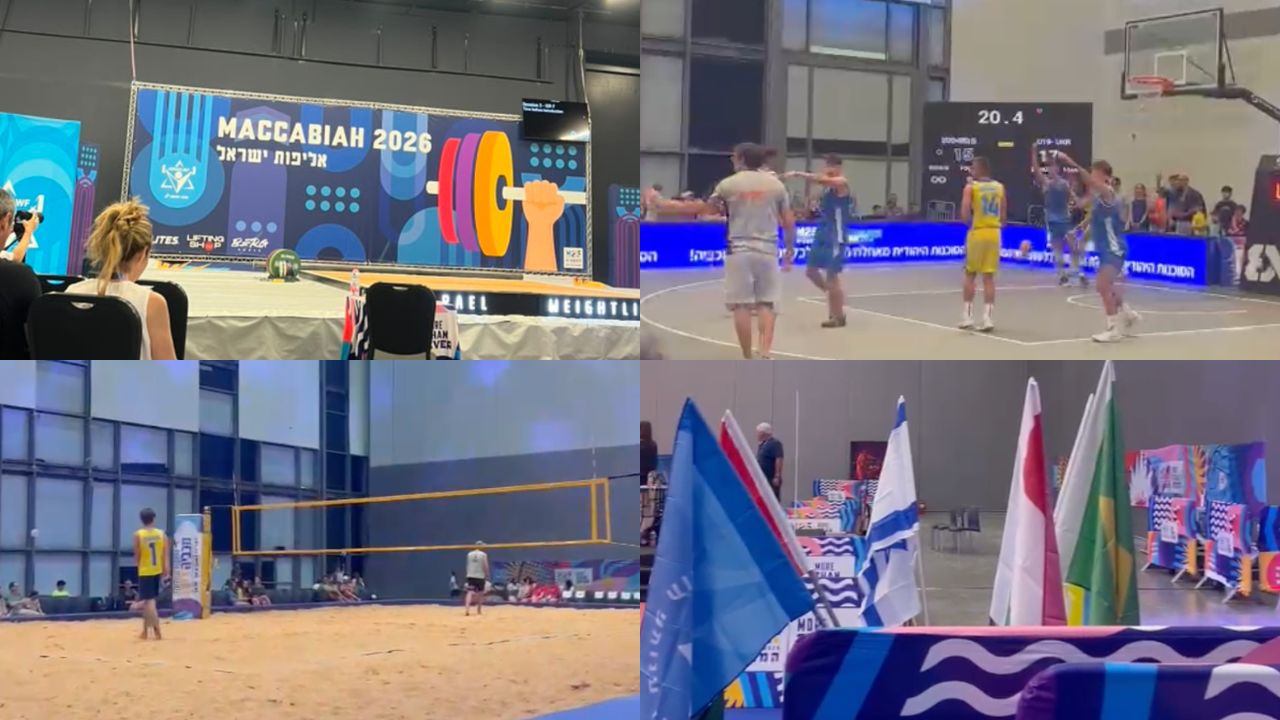
As guests entered Expo Tel Aviv for the 2026 Maccabiah Games, one thing was amiss. All of the branding said M25, not 26. 25 for the year 2025. It was plastered just about everywhere – on banners, signs, even on the court-side displays flanking the 3v3 basketball tournament.
The Maccabiah Games, the competition known as the “Jewish Olympics,” drawing roughly 5,000 athletes from more than 30 countries, included nearly 900 from the United States. The games were postponed a full year after Israel’s surprise attack on Iran shut down airspace and froze the multi-day competition just three weeks before the opening ceremonies could commence. Organizers never changed the name or any of the merchandise. That decision, subtle yet deliberate, says more about the spirit of these Games than any statement could.
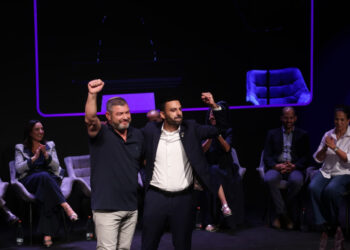
“Israel is kicking, alive, vivid,” he said. “And we know how to appreciate these amazing days, because we know what it means to be in a difficult situation,” said 44-year-old Oren Simanian.
Simanian is the founder of Colleseum Sport, an Israeli sports technology company with offices in Brazil, Ireland, and Munich.
The event included music, food vendors, ping pong tables, a jump rope station, and an e-sports center that guests could enjoy.
Inside the main hall, athletes compete in beach volleyball and on an Israeli Ninja Championship course. On an adjacent court, the U-17 American boys 3×3 basketball team – drawn from various regions like New York, Denver, and California – warmed up for its next game.
For the first time in Maccabiah history, the Games opened their celebrations to the wider Israeli public through a five-day sports festival at Expo Tel Aviv – transforming the venue into an indoor Olympic Village packed with competitions, interactive attractions, and live events. The result feels less like a sports venue and more like a fair that features Jewish Olympic-level athletes spanning from just about all ages, teens to seniors, competing at the center. Kids and family members from all over the country and the world crowd the sidelines to spectate and cheer. People rotate from the Israeli Ninja Championship course to the Sport-TECH innovation exhibit billed as Israel’s largest sports market.
That aforementioned Sport-TECH showcase is where Simanian’s work lives. Colosseum Sport, headquartered in Tel Aviv, curated more than 30 Israeli sports technology inventions for the expo floor. Among them is Playermaker – a sensor worn on an athlete’s boot that tracks movement, speed, and performance data in real time, currently used by top-tier soccer clubs including Argentina’s Olympic national team.
There were other brands dealing with brain training like i-BrainTech, Orca Vision for swimmers, and Baseline Vision for tennis players. Tikkun Olam Makers, an Israeli initiative dedicated to developing low-cost open source solutions for people with disabilities focused on tools enabling injured IDF veterans and Paralympic athletes to train and compete. Rounding out the floor are tools designed to train adults in combat sports – disciplines like boxing, wrestling, and mixed martial arts – where Israeli innovation is finding an expanding global market.
“Israel is known as the startup nation,” Simanian pitched “but it is also the sports tech nation. I want to have a positive impact on the future of sports coming from Israel.”
When asked what it means to compete against other Jewish athletes in Israel specifically, a young American basketball player answer sharpened. “We gotta prove that we’re the best Jews out here,” he said. “But also, there’s this sense of brothership. All these guys, all these people out here – my Jewish brothers and sisters. So it’s an amazing sense of community.”
On the court, there is a genuine sense of competition. By the time it was all said and done, the Americans handled Ukraine comfortably in the semifinals – winning 20-0 – before falling to Israel in the gold medal final, 21-10, in what the players had already identified as their toughest matchup. France claimed Bronze, defeating Ukraine by the same 20-0 margin.
Some of the players are seeing Israel for the very first time, while others have been to the Holy Land before. All came to Israel for three weeks to compete in the Maccabiah games. One theme the players kept coming back to was “community,” a word they independently and repeatedly used to describe the feeling of competing in Israel.
Marshall Einhorn, CEO of the US delegation, called the Games “the most meaningful in a generation,” describing them as the largest gathering of world Jewry since the October 7th massacre, in which the Hamas terror organization killed 1200 people and kidnapped some 250.
The 2026 Maccabiah is collaborating with the IDF Disabled Veterans Organization and, as part of a partnership with the Nova Tribe Community, survivors of the October 7th attacks and their families participated in different roles throughout the Games.
“I invite you to come to Tel Aviv, I invite you to come to Israel, to go to Jerusalem, to go to Haifa, go to the Gaza envelope, go to the north and experience an amazing atmosphere,” Simanian said “and of course, there is the Maccabiah.”
He notes that it is one of the biggest sporting events in the world, and that the purpose is for the global Jewish community to connect and meet new people. The M25 signs stayed up. The Games took place regardless. For Simanian, though, there was never really a doubt. “There’s nothing like being in Israel during summertime,” he said, “and summertime here is the whole year.”











Discussion about this post